- Czech NHL players per million, 2025/26
- 1.8320 players, population 10.9 million · administrative count
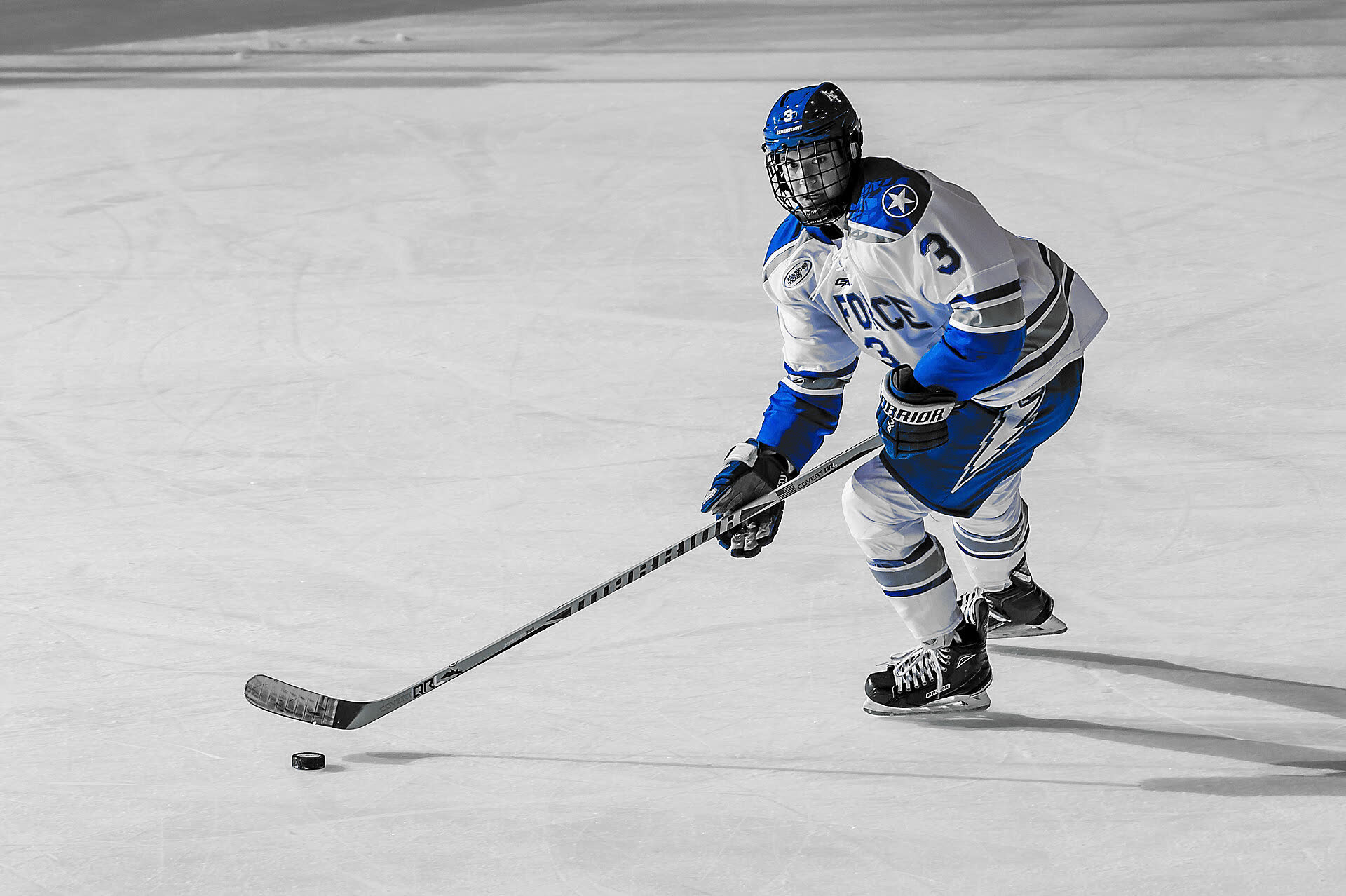
Photo: U.S. Air Force Academy · public domain, colour held
Research · Czech hockey atlas · 1995/96–2025/26
In 2025/26 Czechia ranked 4th of 10 nations for NHL players per million inhabitants.
Photo: U.S. Air Force Academy · public domain, colour held
Research on athlete development asks how players reach the top of a sport and which of them do. Players born early in the selection year are over-represented in youth sport generally and in hockey in particular [1, 2], success in youth national squads is followed by adult success for only some athletes [3], world-class athletes tend to have practised several sports before specialising [4], and professional hockey moves players across national borders [5]. Comparative work on national sport systems proposes a framework of policy factors behind international success [6]. This atlas tests none of these accounts. Its contribution is a descriptive base for the Czech case: from public league statistics and one definition of nationality, it counts how many Czech players reached the NHL and the four strongest European leagues relative to population, against nine peer nations over 31 seasons, and it publishes the counts, their intervals, the player list and the code that rebuilds them.
1
In 2025/26, 20 Czech players reached the games threshold in the NHL, 1.83 per million inhabitants, which ranks Czechia 4th of 10 nations and above the median of the nine peers (1.21).
With the four rung-2 leagues added, the count is 53 players, 4.86 per million, 5th of 10 (peer median 3.55). Sweden (7.26) and Finland (7.25) have about 4 times the Czech NHL rate. These are administrative counts; the Czech ranks are the same under all three games thresholds.
2
The observed Czech NHL count was 58 players in 2001/02 and 20 in 2025/26 (administrative counts).
The break model dates the step whose median is below 1 most likely to 2009/10 (posterior probability 0.09), with a factor of ×0.83 (90 % HDI 0.56–1.14; P(level falls) = 0.80), so its direction is not resolved. The model describes timing, not cause. Conditional on the most probable pair of step seasons, the model level in 2025/26 is 23 players (90 % HDI 18–28), against 53 (90 % HDI 41–62) at its 2002/03 peak.
3
In 2025/26 no Czech forward or defenceman aged 21 or under reached the games threshold in the NHL or rung 2.
Expressed in players at the Czech population, the difference from the median of seven peers is 6.1 for forwards aged 21 or under and 2.8 for forwards aged 22–25. One season is a noisy cross-section: Czech forwards aged 21 or under who reached the threshold numbered 5, 3, 2, 0, 4, 0 in the seasons 2020/21 to 2025/26.
4
Skaters aged 20 or under played 7.9 % of Extraliga skater games, against 14.3 % in the Liiga and 16.7 % in the SHL (means of 12 seasons, 2014/15–2025/26).
The 95 % bootstrap intervals, resampling seasons, are 7.0 %–8.8 %, 12.9 %–15.8 % and 15.5 %–17.9 %. The shares cover players of every nationality and compare leagues, not the chances given to any one player.
5
Over 2020/21–2025/26, the median Czech NHL skater played 0.98 times the median ice time of his league, season and position and scored 0.87 times its points per game (35 players, 111 player-seasons).
The 95 % bootstrap intervals, resampling players, are 0.90–1.11 and 0.68–1.42, so both include 1. In the Liiga the ratios are 1.09 (1.04–1.14) and 1.40 (1.23–1.54), in the SHL 1.08 (0.98–1.18) and 1.30 (0.99–1.59); they compare imported players with each league's own depth and are not comparable across leagues.
6
Across 21 World Championship and Olympic rosters, 2010–2026, Czech roster spots came on average 31 % from the NHL, 28 % from the Extraliga, 25 % from the KHL and 13 % from rung 2.
The KHL share was 33 % over 2010–2022 and 0 % over 2023–2026, when the Extraliga share was 43 %. Without the 2018 and 2022 Olympics, which NHL players did not attend, the NHL share is 34 %. Roster composition reflects nomination as well as the pool.
7
In 2025/26, 11 Czech goalkeepers reached the games threshold in the NHL or rung 2, 1.01 per million, 5th of 10 (peer median 0.53).
In the NHL alone there were 6, 0.55 per million, 4th (peer median 0.11). These are administrative counts of a few players each.
What is counted · Limitations · Every Czech player in the pool · Note: Czech hockey news, 29 September 2026
Šandová, B. (2026). Czech hockey atlas: the player pool. hockey.bsandova.com, version 3. https://hockey.bsandova.com/. Code and data: github.com/sandovabarbora/czehockey-player-pool-atlas.
References 7–10 are cited on the question pages. Data sources, with their access dates and terms, are listed under Data availability.
